
Assessing the Effects of Blessing (Biofield) Energy Treatment on Zea mays L. saccharata Productivity
Abstract
Background
Sweet corn (Zea mays L. saccharata) is a high-demand, nutrient-sensitive cereal crop whose yield and crop quality depend heavily on early vegetative vigor and stress resilience. Spiritual Blessing (Biofield) Energy Treatment (SBET) has emerged as a non-invasive, biostimulatory approach to alter seed germinability, metabolic efficiency, and physiological development without ecological toxicity.
Objective
This study aimed to systematically evaluate the impact of SBET on key morphological attributes, vegetative growth, and reproductive productivity parameters of Zea mays L. saccharata.
Methods
Seeds and plots were assigned to two primary experimental groups: untreated/control sweet corn group (CONSCORG) and a biofield energy treated sweet corn group (BTSCORG) under identical field management practices. Key morphological metrics and post-harvest productivity were evaluated.
Results
Vegetative growth parameters showed substantial gains, including increased stem diameter, leaf width, flag leaf length, flag leaf width, anthesis silk interval, and tassel branching by 29.63% (p ≤ 0.001), 40.06% (p ≤ 0.001), 41.57% (p ≤ 0.001), 48.67% (p = 0.001), 73.21% (p ≤ 0.001) and 35.65% (p = 0.011), respectively, in the BTSCORG than CONSCORG. Moreover, comparative analysis revealed statistically significant improvements of ear/cob length, ear/cob diameter, number of kernels per row, and kernels per plant by 40.22% (p ≤ 0.001), 84% (p ≤ 0.001), 57.16% (p ≤ 0.001), and 37.81% (p ≤ 0.001), respectively, in the BTSCORG compared to the CONSCORG. Furthermore, the grain yield/hectare (ton/h) and straw/stover yield/hectare (ton/ha) were improved by 57.14% and 43.72%, respectively, in the BTSCORG compared to the CONSCORG.
Conclusion
SBET exerted a favorable influence on both vegetative growth parameters and reproductive yield factors in Zea mays L. saccharata.
Article Information
- Received
- Accepted
- Published
Academic Editor: Nabil Elsheery, Agricultural Botany Department, Faculty of Agriculture, Tanta University, Tanta 31527, Egypt.
Checked for plagiarism: Yes
Review by: Single-blind
Copyright © 2026 Alice Branton, et al.
 This is an open-access article distributed under the terms of the Creative Commons Attribution License, which permits unrestricted use, distribution, and reproduction in any medium, provided the original author and source are credited.
Corresponding author: Snehasis Jana, Trivedi Science Research Laboratory Pvt. Ltd., Research and Development, Thane (W), Maharashtra, India —
Competing Interests
Author AB was employed by Trivedi Global, Inc. NRP, TBG, and VDK were employed by Shree Angarsiddha Shikshan Prasarak Mandal’s College of Agriculture, Sangulwadi, Mohitewadi, Maharashtra, India.Authors SM and SJ were employed by Trivedi Science Research Laboratory Pvt. Ltd.
Funding
The authors declare that no funds, grants, or other support were received during the preparation of this manuscript.
Data Availability
No data-availability statement was provided by the authors.
Acknowledgements
The authors are grateful to Divine Connection Foundation for the assistance and support during the work.
Citation:
Introduction
Sweet corn (Zea mays L. saccharata) is one of the most economically significant horticultural crops worldwide, valued for its high endosperm sugar accumulation, dietary fiber, vitamins, and minerals 1. Demand for fresh market and processed sweet corn has increased steadily, driving agricultural research toward optimizing yield potential, kernel quality, and canopy development under variable growing conditions 2. The productivity of sweet corn (Zea mays L. saccharata) was intrinsically linked to key morphological characteristics established during early vegetative growth, including plant height, leaf area development, stem girth, and ear height 3. Morphological architecture directly determines light interception efficiency, photosynthate partitioning, and ultimate ear yield parameters such as cob length, ear diameter, and row number per ear in sweet corn 4. To maximize sweet corn (Zea mays L. saccharata) yield, modern farming systems have heavily depended on agrochemicals and synthetic growth regulators 5, 6.
However, over-reliance on chemical inputs raises environmental sustainability concerns and highlights the need for non-invasive, eco-friendly biophysical approaches to enhance physiological efficiency, vegetative biomass, and harvest index in sweet corn 7. Among emerging biophysical technologies, Biofield Energy Treatment (The Trivedi Effect®) has demonstrated significant potential in modulating plant cellular metabolism, seed germination vigor, photosynthetic capacity, and crop yield attributes 8, 9. Biofield energy applications involve subtle electromagnetic/energy interactions that can alter physiological pathways without altering genetic integrity or relying on harmful chemical residues. Although various management strategies have been thoroughly investigated to improve sweet corn morpho-physiological traits 10, while the specific impact of Blessing (biofield) Energy Treatment on sweet corn (Zea mays L. saccharata) remains unexplored. Therefore, the primary objective of this study was to evaluate the effects of Blessing/Biofield Energy Treatment on the morphological development (plant height, stem diameter, leaf traits) and overall productivity parameters (ear weight, cob length, green cob yield) of sweet corn (Zea mays L. saccharata).
Materials and Methods
Experimental location and regional climate
The experimental site was located in Bhandarwadi, Sindhudurg, Maharashtra, India (15°37′–16°40′ N, 73°19′–74°13′ E; 26 meters above the mean sea level), representing the tropical Konkan agro-climatic zone. Regional climatic conditions feature extreme pre-monsoon thermal peaks (38–40 °C) and a hyperthermic regime. Interannual rainfall fluctuations induce acute seasonal soil moisture stress, which adversely impacts crop physiological processes during key phenological transitions.
Seed origin and field trial design
Sweet corn seeds (Zea mays L. var. saccharata, cultivar 'Hybrid'; 95% seed purity, Lot No. 20017803, Label 315) were procured from Syngenta India Pvt. Ltd., India. The field experiment was conducted using a randomized complete block design (RCBD) with three replicates across two treatment groups: untreated/control sweet corn (CONSCORG) and biofield energy-treated sweet corn (BTSCORG). To minimize confounding factors, all treatment plots were cultivated under identical environmental and agronomic conditions following standardized protocols for irrigation, fertilization, and pest management.
Field layout
The experiment was laid out in a randomized complete block design (RCBD) covering a total footprint of 70.0 m². The design consisted of six 9 m² individual plots (3 m × 3 m), each separated by 0.6 m buffer zones. Crops were established on a 0.5 m × 0.5 m grid, achieving a planting density of 4 plants m⁻².
Spiritual blessing (biofield/prayer) energy treatment (SBET) strategy
Distant spiritual blessing (biofield) energy treatment (SBET; The Trivedi Effect®) was administered to the experimental group (BTSCORG; sweet corn seeds and soil) by a practitioner with over 14 years of experience (Ms. Alice Branton, Florida, USA) via a real-time online web-conferencing platform. The treatment consisted of a single, 4-minute session under monitored ambient conditions (28 ± 2 °C and 65 ± 5% relative humidity). The control group (CONSCORG; seeds and soil) received no treatment and was maintained under identical environmental conditions.
Soil characterization and sample preparation
To establish baseline physicochemical properties, we collected composite topsoil samples (30 cm depth from the surface) from five systematic points per plot. Samples were air-dried at ambient temperature, sieved (<2 mm), and stored at 4 °C. We determined particle size distribution following 11 and measured soil pH potentiometrically in a 1:2 (w/v) soil-to-deionized water suspension.
Irrigation and crop management
Plots were manually irrigated for 7 days post-sowing to facilitate crop establishment. Irrigation was subsequently supplied via a surface drip system featuring pressure-compensating emitters (0.5 m emitter spacing, nominal flow rate of 3.0 L h⁻¹).
Fertilization and plant protection
Baseline nutrients were applied at a rate of 50:100:50 kg ha⁻¹ (N:P:K). Full doses of phosphorus (as single superphosphate), potassium (as muriate of potash), and 50% of nitrogen (as urea) were basal-incorporated at sowing. The residual 50% N was side-dressed at 21 days after sowing (DAS). To eliminate pest damage as a confounding variable, a commercial insecticide mixture, Hamla 550 (500 g L⁻¹ chlorpyrifos + 50 g L⁻¹ cypermethrin), Gharda Chemicals Ltd., India was applied as a foliar spray at a concentration of 2 mL L⁻¹.
Growth and morphological parameters
We evaluated vegetative and reproductive parameters at 80 days after sowing (DAS) using five randomly sampled sweet corn plants per plot. Pre- and post-flowering phenotyping captured growth habit, stem diameter, leaf morphology, flowering dynamics, and ear development traits. At the plot scale, we recorded emergence efficiency, phenological milestones (days to 50% tasseling and silking), the anthesis–silking interval, ear geometry (length and diameter), days to 80% maturity, and key yield metrics.
Yield parameters
Upon reaching physiological maturity, ears were harvested, and five representative plants per plot were randomly sampled to evaluate ear physical characteristics (length, diameter, and fresh mass). Plot yield (kg) was converted to a tonnes-per-hectare basis.
Statistical analysis
Data are expressed as the mean ± standard error of the mean (SEM). Inter-group comparisons across the two independent cohorts were conducted via a two-tailed Student’s t-test. Analyses were run using SigmaPlot (version 14.0), and the threshold for statistical significance was predetermined at p < 0.05.
Results
Soil properties
Compared with CONSCORG, the BTSCORG treatment significantly modified the sandy loam soil matrix, leading to an increased water-holding capacity and higher concentrations of exchangeable cations (Ca2+, Mg2+, and Na+; p < 0.05) (data not shown).
Phenological progression and morphology of Zea mays
To map the ontogenesis of sweet corn (Zea mays Saccharata L.) we systematically tracked its morphology across distinct growth stages. This study provides a quantified phenological timeline that captures critical developmental milestones from germination and seedling establishment through vegetative expansion, anthesis, and fruit maturation (Figure 1).
Figure 1. Sample images illustrate the changes at various stages of the sweet corn's vegetative and reproductive growth characteristics. C, control group; T, Blessing/biofield energy treated group. R1: Silking, R2: Blistering, R3: Milking, R4: Doughing, R5: Denting, R6: Physiological maturity. 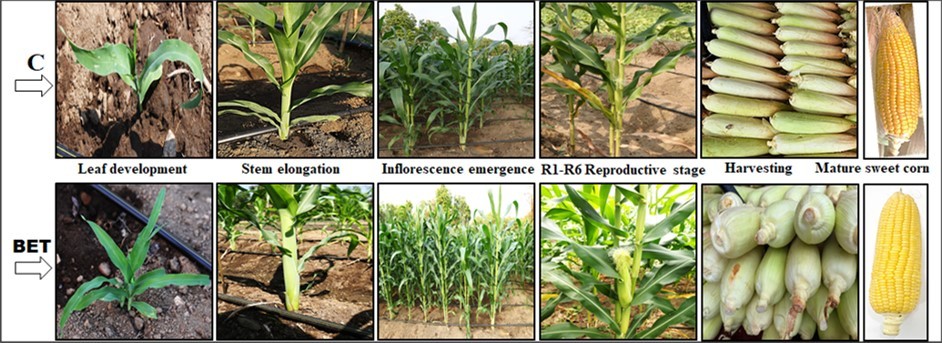
Download figure
Morphological characteristics
Leaf colour was dark green in the biofield energy-treated group (BTSCORG) as compared to the control group (CONSCORG), green. Drooping leaf orientation was observed for CONSCORG and erect for BTSCORG. Leaf pubescence was present in the BTSCORG, while it was absent in the CONSCORG. The tassel texture of CONSCORG was lax (less dense) and dense for BTSCORG. The tassel-anther glume colour of sweet corn was light yellowish green in the CONSCORG group and BTSCORG had white yellowish colour. The tassel-glume base colour of sweet corn was absent in the CONSCORG group and present in the BTSCORG. The silk colour at emergence in the BTSCORG and CONSCORG group was light white and light yellowish green, respectively. The ear (cob) shape was cylindrical conical for CONSCORG, and cylindrical for BTSCORG. The kernel colour of BTSCORG and CONSCORG groups was intense yellow and light yellow, respectively. Husk cover was very good in the BTSCORG, while good in the CONSCORG. The kernel/grain texture, taste, and size of BTSCORG were soft, sweeter, and larger, whereas those of the CONSCORG group were slightly soft, less sweet, and medium. Both BTSCORG and CONSCORG had smooth leaf texture, upright plant growth habit, broad leaf width, presence of anthocyanin pigment, regular kernel row arrangement, and flat grain shape (Table 1).
Table 1. Impact of blessings (biofield) energy treatment on qualitative vegetative parameters of sweet corn at 80 days after sowing (DAS).| Vegetative trait | Control group (CONSCORG) | Treatment group (BTSCORG) |
| Plant growth habit | Upright | Upright |
| Leaf color | Green | Dark green |
| Leaf orientation | Dropping | Erect |
| Leaf pubescence | Absent | Present |
| Leaf texture | Smooth | Smooth |
| Leaf width | Broad | Broad |
| Anthocyanin pigmentation | Present | Present |
| Tassel texture | Lax (less dense) | Dense |
| Tassel-anther glume colour | Light yellowish green | White yellowish |
| Tassel-glume base colour | Absent | Present |
| Silk colour at emergence | Light yellowish green | Light white |
| Ear shape | Cylindrical conical | Cylindrical |
| Husk cover | Good | Very good |
| Kernel row arrangement | Regular | Regular |
| Kernel color | Light Yellow | Intense yellow |
| Grain texture and taste | Slightly soft and less sweet | Soft and sweeter |
| Grain shape | Flat | Flat |
| Grain size | Medium | Large |
Phenology and yield traits
The rate of germination was significantly increased by 13.50% (p ≤ 0.001) in the BTSCORG compared to the CONSCORG.Plant height and stem diameter were significantly increased by 18.14% (p ≤ 0.001) and 29.63% (p ≤ 0.001), respectively, in the BTSCORG compared to the CONSCORG.Number of leaves per plant, leaf length, leaf width, flag leaf length, and flag leaf width were significantly increased by 18.75% (p ≤ 0.001), 26.84% (p ≤ 0.001), 40.06% (p ≤ 0.001), 41.57% (p ≤ 0.001), and 48.67% (p = 0.001), respectively, in the BTSCORG than CONSCORG. Anthesis silk interval and tassel branching were significantly improved by 73.21% (p ≤ 0.001) and 35.65% (p = 0.011), respectively, in the BTSCORG than CONSCORG. The BTSCORG took less time to 80% fruit manifestation compared to the CONSCORG. Fruit pedicel length, ear/cob length, and ear/cob diameter were significantly increased by 26.39% (p ≤ 0.001), 40.22% (p ≤ 0.001), and 84% (p ≤ 0.001), respectively, in the BTSCORG with respect to CONSCORG. Number of husks per ear, number of kernels per row, kernels per plant, and 100-gram seed weight were significantly increased by 22.96% (p ≤ 0.001), 57.16% (p ≤ 0.001), 37.81% (p ≤ 0.001), and 11.28% (p ≤ 0.001), respectively, in the BTSCORG compared to the CONSCORG. Finally, the grain yield/hectare (ton/h) and straw/stover yield/hectare (ton/ha) were improved by 57.14% and 43.72%, respectively, in the BTSCORG compared to the CONSCORG (Table 2).
Table 2. Evaluation of the phenological and yield characteristics of sweet corn following spiritual (biofield/prayer) blessing energy treatment (SBET).| Vegetative trait | Control group (CONSCORG) | Treatment group (BTSCORG) | P value |
| Days to germination | 5 -7 | 5- 6 | - |
| Germination percentage | 86.34 ± 0.45 | 98.00 ± 0.06 | p ≤ 0.001 |
| Plant height (cm) | 203.38 ± 3.21 | 240.27 ± 2.16 | p ≤ 0.001 |
| Stem diameter (cm) | 3.24 ± 0.03 | 4.20 ± 0.07 | p ≤ 0.001 |
| Number of leaves per plant | 15.68 ± 0.40 | 18.62 ± 0.17 | p ≤ 0.001 |
| Leaf length (cm) | 75.38 ± 1.18 | 95.61 ± 1.28 | p ≤ 0.001 |
| Leaf width (cm) | 7.24 ± 0.09 | 10.14 ± 0.09 | p ≤ 0.001 |
| Flag leaf length (cm) | 37.24 ± 2.02 | 52.72 ± 1.58 | p ≤ 0.001 |
| Flag leaf width (cm) | 4.15 ± 0.18 | 6.17 ± 0.36 | p = 0.001 |
| Days to 50% tasseling | 72.11 ± 1.45 | 70.84 ± 1.37 | p = 0.542 |
| Days to 50% silking | 72.68 ± 1.19 | 71.46 ± 1.38 | p = 0.522 |
| Anthesis silk interval | 2.24 ± 0.06 | 3.88 ± 0.07 | p ≤ 0.001 |
| Tassel branching | 19.16 ± 1.38 | 25.99 ± 1.53 | p = 0.011 |
| Days to 80% fruiting | 77.21 ± 1.46 | 72.68 ± 1.25 | p = 0.046 |
| Fruit pedicel length (cm) | 5.04 ± 0.04 | 6.37 ± 0.03 | p ≤ 0.001 |
| Ear/cob length (cm) | 17.13 ± 0.56 | 24.02 ± 0.12 | p ≤ 0.001 |
| Ear/cob diameter (cm) | 3.25 ± 0.03 | 5.98 ± 0.06 | p ≤ 0.001 |
| Number of husks per ear | 9.58 ± 0.05 | 11.78 ± 0.04 | p ≤ 0.001 |
| Number of kernels per row | 27.64 ± 0.89 | 43.44 ± 0.21 | p ≤ 0.001 |
| Number of kernel rows per ear | 12.11 ± 0.06 | 12.13 ± 0.10 | p = 0.868 |
| Kernels per plant | 621.38 ± 31.68 | 856.35 ± 28.53 | p ≤ 0.001 |
| Kernel weight (g) | 0.22 ± 0.04 | 0.25 ± 0.02 | p = 0.521 |
| Grain yield per plant (kg/plant) | 0.14 | 0.22 | - |
| Crop duration (days) | 96.34 ± 2.04 | 93.61 ± 1.28 | p = 0.290 |
| 100-grain seed weight (g) | 24.12 ± 0.14 | 26.84 ± 0.07 | p ≤ 0.001 |
| Total grain yield (kg) | 4.04 | 5.7 | - |
| Grain yield/sq. m plot (kg/sq. m) | 0.56 | 0.88 | - |
| Grain yield/hectare (ton/h) | 5.60 | 8.80 | - |
| Straw yield per plant (kg/plant) | 0.62 | 0.95 | - |
| Total stover/straw yield (kg) | 17.85 | 25.65 | - |
| Straw yield/sq. m plot (kg/sq. m) | 0.66 | 0.95 | - |
| Straw/stover yield/hectare (ton/ha) | 6.61 | 9.50 | - |
Discussion
The experimental findings demonstrate that the Biofield Energy Treated Sweet Corn (BTSCORG) group achieved statistically significant enhancements across phenological stages, vegetative canopy structure, reproductive synchrony, and yield attributes compared to the Control Sweet Corn (CONSCORG) group. The significant increase in germination rate in the BTSCORG relative to CONSCORG reflects enhanced cellular activation and physiological vigor during early seed imbibition. Rapid and uniform seed germination was a crucial prerequisite for establishing optimal plant density and uniform canopy development in sweet corn 12. The accelerated germination kinetics observed here align with the broader metabolic responsiveness reported in biofield-treated crop systems by Trivedi et al. 2015 13, where biofield intervention promoted early enzymatic and growth dynamics.
Morphological parameters indicated a substantial expansion in vegetative biomass in BTSCORG, marked by increased plant height and stem diameter. Canopy leaf development showed consistent enhancements across all dimensions: total leaves per plant, leaf length, leaf width, flag leaf length, and flag leaf width. The expansion of flag leaf area was particularly vital in sweet corn, as flag leaves serve as the predominant photosynthetic source organ supplying assimilate directly to the developing ear, as demonstrated by Williams et al. 2008 10. The increased leaf area and stem girth provided both the structural stability needed to resist lodging and the light-harvesting capacity required to fuel reproductive sink growth. A narrow anthesis-silk interval (ASI) was critical in sweet corn production to ensure complete pollination and prevent kernel abortion caused by asynchronous silk emergence relative to pollen release. In BTSCORG, ASI was significantly improved alongside an increase in tassel branching and a shorter duration to reach 80% fruit manifestation. In sweet corn field systems, reproductive synchrony and robust tassel structure directly enhance pollen shed coverage and silk receptivity, as documented by Oktem et al. 2003 14. In this study, the dramatic increase in ASI in the BTSCORG facilitated optimal fertilization conditions, laying the foundation for maximum kernel set per cob.
The reproductive capacity of sweet corn was defined by cob structural dimensions and kernel row filling. Biofield treatment significantly expanded ear structural characteristics, including fruit pedicel length, ear/cob length, ear/cob diameter, and husks per ear. This architectural expansion accommodated major increases in sink attributes such as kernels per row, kernels per plant, and 100-gram seed weight. These morphological gains correspond to established sweet corn yield models by Williams et al. 2015 10, where cob diameter, row number, and seed weight were identified as primary determinants of total ear weight and commercial yield grade.
The accumulated physiological advantages in vegetative vigor, leaf photo-assimilatory capacity, and reproductive synchrony translated into final field productivity. Grain yield per hectare and straw/stover yield per hectare were improved in the BTSCORG compared to the CONSCORG. The concurrent improvement in both stover biomass and grain yield indicates efficient photoassimilate partitioning and source-to-sink translocation throughout the crop lifecycle. These integrated yield gains reinforce earlier findings on non-invasive biostimulatory strategy applications in agricultural crops reported by Wang et al. 2026 15, highlighting the potential of a non-invasive biostimulatory strategy to enhance growth, morphological development, and overall productivity in sweet corn agroecosystems.
Conclusion
The application of Spiritual Blessing Biofield Energy Treatment (The Trivedi Effect®) significantly promoted vegetative vigor, enhanced reproductive morphology, and boosted total crop yield in Zea mays L. saccharata. These findings suggest that non-contact biophysical energy interventions offer a promising, sustainable complementary modality for optimizing crop morphology and field productivity in sweet corn cultivation.
Abbreviations
- SBET: spiritual blessing energy treatment
- RCBD: randomized complete block design
- CONSCORG: control sweet corn group
- BTSCORG: biofield energy-treated sweet corn group
- DAS: days after sowing
- SSP: single super phosphate
- MOP: muriate of potash
References
- 1.Ifie S E, Dangana R S, Swase D, Ben Okon M, Makena W et al. (2026) Nutritional composition of Zea mays L: A comprehensive review of macronutrients, micronutrients, and bioactive compounds. Open Research Africa 8, 15-10.
- 2.Yilmaz E, Akcay S, Gürbüz T, Dağdelen N, Sezgin F. (2010) Effect of different water stress on the yield and yield components of second crop corn in semiarid climate. Journal of Food, Agriculture and Environment 8(3), 415-421.
- 3.Singh M V, Kadam S B, Chavan P G, Pagar P A, Patil P V. (2025) Yield performance and economic evaluation of sweet corn (Zea mays L. Saccharata) cultivars under different sowing dates. International Journal of Advanced Biochemistry Research 9(7), 924-926.
- 4.Rajesh H, Yadahalli G S, Chittapur B M, Halepyati A S, Hiregoudar S. (2021) Growth, yield and economics of sweet corn (Zea mays L. Saccarata) as influenced by foliar sprays of nano fertilisers. Journal of Farm Sciences 34(4), 381-385.
- 5.Lahay R R, Sipayung R, Sabrina T T. (2019) The growth and yield of sweet corn (Zea mays saccharata Sturt.) with anorganic and organo-bio fertilizer. IOP Conference Series: Earth and Environmental Science 260(1), 012156-10.
- 6.Suraj M, Somangouda G, Salakinkop S R. (2020) Yield and yield attributes of sweet corn (Zea mays L. saccharate) as influenced by split application of nitrogen and potassium during kharif under protective irrigation. Journal of Entomology and Zoology Studies 8(4), 361-364.
- 7.Oktem A. (2008) Mineral composition of some sweet corn (Zea mays L. saccharata Sturt.) genotypes under semi arid region. Asian Journal of Chemistry 20(1), 723-730.
- 8.Branton A, Gaikwad T B, Phutankar N R, Kadam V D, Mondal S et al. (2026) Measuring the phenological response and yield of cucumbers to distant spiritual blessing energy treatment. BioMed Research Journal 9(1), 875-880.
- 9.Branton A, Gaikwad T B, Phutankar N R, Kadam V D, Mondal S et al. (2026) Unveiling the influence of spiritual blessing energy treatment on the cultivation, growth and production of bottle gourd (Lagenaria siceraria L.). International Journal of Agriculture and Technology 6(2), 1-5.
- 10.Williams M M. (2008) Sweet corn growth and yield responses to planting dates of the North Central United States. HortScience 43(6), 1775-1779.
- 11.Richer-de-Forges A C, Arrouays D, Chen S, Dobarco M R, Libohova Z et al. (2022) Hand-feel soil texture and particle-size distribution in central France. Relationships and Implications. CATENA 213, 106155-10.
- 12.Fahrurrozi F, Muktamar Z, Dwatmadji D, Setyowati N, Sudjatmiko S et al. (2016) Growth and yield responses of three sweet corn (Zea mays L. var. Saccharata) varieties to local-based liquid organic fertilizer. International Journal on Advanced Science, Engineering and Information Technology 6, 319-323.
- 13.Trivedi M K, Branton A, Trivedi D, Nayak G, Gangwar M et al. (2015) Agronomic characteristics, growth analysis, and yield response of biofield treated mustard, cowpea, horse gram, and groundnuts. International Journal of Genetics and Genomics 3(6), 74-80.